Discovering underwater sounds
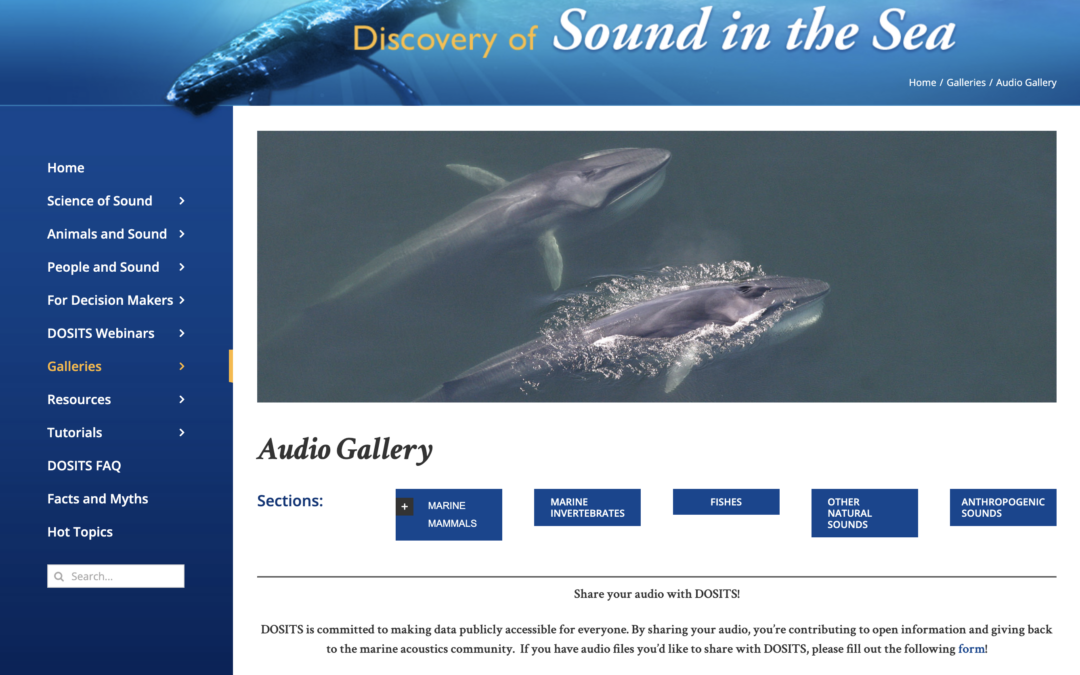
The Discovery of Sound in the Sea (DOSITS) project is the ideal starting point for anyone wishing to take part in Listening to the Ocean. Led primarily by the University of Rhode Island in the United States, it contains a wealth of scientific content on all aspects of sound in the marine environment, including sections aimed at teachers and pupils. It includes resources explaining how sound travels through water from a physical perspective, as well as a wide variety of sound recordings – both natural and man-made – all accompanied by explanations accessible to a non-specialist audience.
The content is divided into three main sections: scientific concepts relating to sound (propagation, frequency, measurement); animals and sound – how marine mammals, fish and crustaceans produce and perceive sounds; and human applications, such as in navigation or construction. The pages are presented in the form of questions, such as ‘What is a soundscape?’.
The audio gallery features recordings of marine mammals, fish and invertebrates, as well as natural sounds (rain, ice, earthquakes, waves) and man-made sounds (ships, sonar, wind turbine pile driving). This resource is well suited to listening sessions where pupils can, for example, be asked to describe sounds or formulate hypotheses about their origin before discovering the explanations.
The other galleries, on technologies, scientists and professions, provide further information on ocean researchers and their methods. Four videos offer insights into the science of sound, the hearing of marine mammals and fish, and the assessment of risks associated with human activities. Finally, a glossary and a ‘Facts and Myths’ section help to dispel common misconceptions and clarify general knowledge.
Ready-to-use teaching modules
The Classroom Activities page currently features five teaching activities suitable for different levels:
- A Cup of Sound – exploring the pitch of sounds produced using cups and strings made from different materials (primary level)
- Thinking Inside the Box – using a box simulating the seabed, pupils take measurements, which helps them understand how sonar works (activities differentiated by level, from primary to sixth form)
- Spectrograms – creating and analysing spectrograms from sound recordings made by pupils (activities differentiated by level, from primary to secondary school)
- Stirring up Sound – investigating the effect of temperature on the speed of sound and on diffusion through particles and bubbles (secondary school level)
- How to Build a Hydrophone – building a low-cost hydrophone to listen to an aquarium or a nearby body of water (secondary school level)
The website also features games and quizzes with ready-made PDFs, as well as an archive of webinars featuring guest researchers. Finally, since spring 2026, DOSITS has been offering an online certification programme for teachers.
A future collaboration
DOSITS’ resources are currently available only in English, which limits their use in the French-speaking world. A collaboration with DOSITS is being considered as part of the Listening to the Ocean project, with a view to translating some of these resources into French. If you would like to contribute to this translation, please write to contact.listeningtotheocean@gmail.com
.